When the Heist Becomes the Mirror: Why Castle Cagliostro Is Lupin III's Most Emotionally Honest Film
There's a version of Lupin III that shows up in nearly every episode, every TV special, every movie that isn't Castle Cagliostro. He's slick. He's untouchable. He cracks a joke while rappelling off a burning building, and you believe him completely. That Lupin is a joy to watch — a cartoon id dressed in a colored jacket, running from Zenigata and toward whatever shiny object caught his eye this week.
Then there's the Lupin in Hayao Miyazaki's 1979 film. Same face. Same jacket. Completely different emotional geography.
Castle Cagliostro doesn't just tell a different kind of Lupin story. It interrogates what a Lupin story even is — and in doing so, it became the franchise's defining document for Western audiences who'd never seen a single episode of the TV series.
A Castle That Thinks Back at You
Most heist targets in the Lupin universe are passive. A vault. A museum. A private collection locked behind laser grids and bored security guards. The target exists to be cracked, and the fun is watching Lupin crack it.
Cagliostro Castle is not passive. It watches.
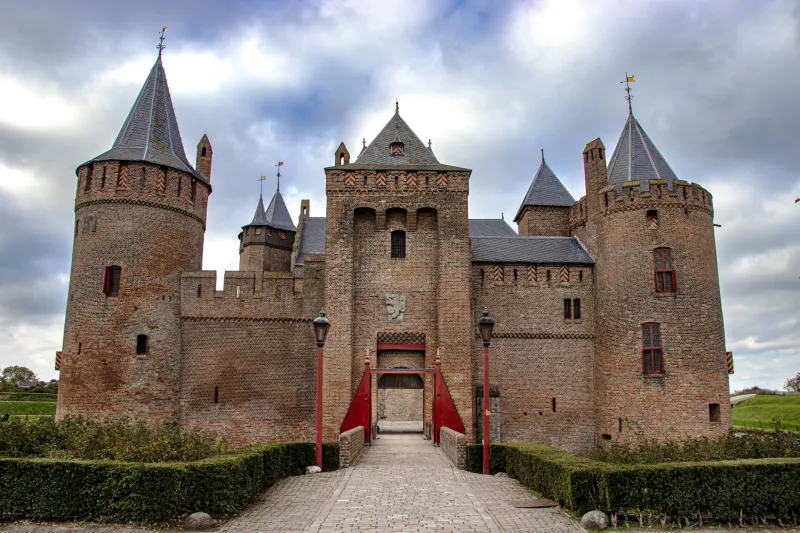
Miyazaki designed the castle as a living architectural argument — a place with centuries of secrets baked into its stone, its waterways, its underground chambers. When Lupin moves through it, the building pushes back. Hidden rooms redirect him. Traps swallow his plans whole. The castle has its own logic, its own history, and it does not yield easily to a man used to environments that bend around his genius.
That resistance is the point. For maybe the first time in the franchise's history, Lupin is operating in a space that genuinely outmatches him on home turf. And that structural shift — from Lupin as master of his environment to Lupin as someone who has to earn the space — creates room for something the TV series rarely allowed: vulnerability.
The Score That Isn't a Score
Here's the thing about the Cagliostro heist that makes it structurally strange: Lupin already knows the legendary Cagliostro gold is probably a dead end. He's been there before. He walked away empty-handed once, and the memory of that failure is one of the few things the film suggests actually bothers him.
So why go back?
The answer arrives in the form of Clarisse — a young woman trapped in a forced marriage to the Count, running from her own castle like it's a prison. And for Lupin, a man who has spent his entire career taking things from places, the decision to protect someone instead of extracting something creates a genuine identity crisis the film never quite names out loud but absolutely earns.
This is where Cagliostro separates from the rest of the franchise. The emotional stakes and the material stakes are no longer pointing in opposite directions. Saving Clarisse is the heist. Exposing the Count is the score. The castle's secrets — its counterfeit operation, its underground ruins, its clock tower — all converge on a single moral question that Lupin has never had to answer before: what is he actually willing to risk himself for?
In most Lupin stories, that question is irrelevant because Lupin never really risks anything. He's too good. Here, he bleeds. He loses. He gets beaten badly enough that Jigen and Goemon have to pull him out of situations his own cleverness couldn't solve. That's not just unusual for the franchise — it's almost radical.
Miyazaki's Sleight of Hand
What Miyazaki understood — and what makes this film so rewatchable even forty-plus years later — is that the best way to reveal a character is to put them somewhere that doesn't accommodate their usual performance.
Lupin's usual performance is detachment. He steals, he winks, he escapes. Emotional investment is for suckers and Zenigata. But the castle strips that performance down layer by layer, and what's underneath is genuinely surprising: a man who cares deeply about justice, who has a complicated and protective relationship with innocence, and who is capable of walking away from a legendary treasure if the human cost isn't worth it.
That last part is crucial. The famous ending — Lupin standing in the ruins of the clock tower, gold coins raining into the lake, grinning like he planned the whole thing — reads differently once you understand what he gave up to get there. He didn't come for the coins. He came to break the machine. And breaking the machine meant letting the treasure go.
For a franchise built on acquisition, that's a genuinely subversive conclusion.
Why American Audiences Connected So Hard
Castle Cagliostro was many Americans' introduction to Lupin III — often through grainy VHS copies in the late '80s and early '90s, or through the Streamline Pictures dub that turned it into something approximating a Saturday afternoon adventure movie. And while the dubbing choices were sometimes questionable, the core of the film survived every translation.
American audiences, raised on a steady diet of Han Solo and Indiana Jones, immediately understood the archetype Miyazaki was playing with: the rogue with a hidden conscience. The guy who says he's only in it for himself right up until the moment he absolutely isn't. That character type is embedded in American pop mythology in a way that transcended any unfamiliarity with anime conventions.
Cagliostro gave American viewers a Lupin they could hold onto — emotionally legible, morally coherent, exciting without being nihilistic. It's no coincidence that the film functioned as a gateway drug for an entire generation of Western anime fans. It offered all the kinetic energy of the franchise with an emotional throughline that felt universal.
The Franchise Changed, Whether It Admitted It or Not
Here's the uncomfortable truth that Lupin III fans have wrestled with for decades: the franchise never quite replicated what Cagliostro did, and it probably couldn't. The episodic, breezy nature of the TV series is a feature, not a bug. You can't run a weekly show on the emotional register of that film without burning everyone out.
But Cagliostro's influence is everywhere. Every subsequent Lupin project that tried to give the character genuine emotional depth — Part IV's Italy arc, the Woman Called Fujiko Mine series, the more introspective TV specials — owes a debt to what Miyazaki proved was possible in 1979. He demonstrated that Lupin could carry weight without losing his lightness. That the thief and the idealist could occupy the same body without the whole thing collapsing into contradiction.
The castle in Cagliostro is a mirror. Walk through it with Lupin, and you don't just see what he's stealing — you see what he's protecting, what he regrets, and what he's willing to lose. That's not a heist movie. That's a character study wearing a heist movie's clothes.
And honestly? It's the best thing the franchise ever produced.